Showing posts with label Article. Show all posts

Thursday, June 10, 2021

Article: Live Nation is wiring more than 60 venues for livestreaming

Well I guess it still makes sense… 

"This is potentially a brilliant business move, because not only will livestreaming repeatedly capture superfans who would happily spend an evening and $120-$600 on tickets, but it will increase access for fans whose towns and budgets do not align with tours. Perhaps more critically, it will reach the many (many) semi-fans who would not tromp through crowds to see Pink, but would totally pay $15-40 to project her onto their living room wall.

Other soon-to-be-livestreaming venues range from clubs to amphitheaters. They include House of Blues locations in Chicago and New Orleans; The Filmore venues in San Francisco and Philadelphia; The Gorge in George, Washington; and Shoreline Amphitheater in Mountain View, California. So far artists including Liam Payne, Louis Tomlinson and Brandi Carlile have performed livestreams."

(Via Live Nation is wiring more than 60 venues for livestreaming.)

Article: Live Music Should Be More Accessible For Disabled Fans

YES.  Yes it should.

"There are other ways venues, bands, and booking agents can build a more inclusive environment. Maja Liv Groves, the founder of Queers to the Front, a booking agency and music company 'prioritizing all marginalized people, which very much includes people with all sorts of disabilities,' has historically asked venues who host her bands to go above and beyond the status quo for disabled accommodations. 'I definitely experienced things where I would ask for a ramp to the entrance to the venue and they'd ask if I was disabled and I'd reply, 'does it matter?,' said Groves. 'If you want the show to be accessible, you should want everybody to have access to the show, not just your performer.' Other measures include asking to remove stroboscope lighting for people with photosensitivity or epilepsy, accessible unisex restrooms, and other easy solutions. 'Everybody has different accessibility needs,' said Dykema. 'What is accessible to me doesn't necessarily mean it's fully accessible to everybody.'"

(Via Live Music Should Be More Accessible For Disabled Fans.)

Friday, January 15, 2021

Article: A Tale Of Two Ecosystems: On Bandcamp, Spotify And The Wide-Open Future

A great article that really carves out the different approaches as to how we support music.  

"Spotify and Bandcamp could not be more opposite. Where Spotify highlights playlists, most often of its own creation, Bandcamp sticks to the album (or any other format, as determined by the artist). Where Spotify pays royalties according to little-understood formulas that can only be analyzed by reverse calculation, Bandcamp lets artists and labels choose their own prices. Where Spotify requires working through a limited number of distributors to access their services, Bandcamp is open to anyone. Where Spotify has revenue streams dependent on ads and data, Bandcamp operates on a simple revenue share with artists and collects no information on its users.

Spotify is now worth an estimated $54 billion on the stock market, despite having never shown an annual profit. Bandcamp is privately owned, has been in the black since 2012, and continues to grow... slowly. You might be tempted to say that one is a 21st-century business, and the other belongs to an earlier age. But neither could exist at any other time."

A fun little trip down memory lane.

"'It definitely started as a digital platform,' says Diamond. 'In 2007, when we started the company, streaming didn't exist in the United States and our competition essentially was piracy. And the idea in 2007 primarily was that nobody was going to pay for music anymore. And it just seemed very obvious to me that if you like some music from one of your favorite artists, you should be able to support them directly. And so we built the platform to do that. My reference point for this was blogging services. In 2007, you had Blogger, Typepad, Movable Type, services that were essentially like white label services for writers – you could set up a site within minutes and tap this direct relationship with your readers. And it seemed crazy to me that if your artistic output happened to be music instead of words, you were just out of luck.' 

'And the most promising thing that happened in the early days,' Diamond continues, 'was we immediately saw people start to actually buy music, which was very exciting. I wasn't sure that was going to happen! And then, one of the fun things that happened was we started to look at the search terms people were using that brought them to a Bandcamp artist's site that led to a purchase. And several times per hour, we were seeing search terms like the name of an album or name of a track plus the word 'torrent,' or plus the word 'Limewire' or 'Kazaa.' You know, this was somebody whose intent initially was just to get the music – I don't know if they were thinking 'I'm pirating the music' – but they were trying to get it for free. But when they saw that they could make a direct purchase to the artist, they wanted to do that. And that just warmed my heart. So that's really what we were trying to do from the beginning, was just make it clear that this was a way to show your direct support for an artist.'"

While I’m definitely on team Bandcamp, I’m also a subscriber to Apple Music.  For me there’s room for both, as I use Apple Music to explore new music, and Bandcamp to support the artists I like.

(Via A Tale Of Two Ecosystems: On Bandcamp, Spotify And The Wide-Open Future : NPR.)

Friday, November 6, 2020

Look Inside the World's Largest Collection of Pop Music: THE ARCHIVE

Fascinating. 🤓

Look Inside the World's Largest Collection of Pop Music: THE ARCHIVE

What do you do with one of the largest record collections in the world? You put the three million items in a building in lower manhattan. That is, until you're thrown out...VNT goes to see the dressing of the dead at the ARChive of Contemporary Music-- and a look at its next iteration, wherever that might be.

Thursday, October 15, 2020

Article: The Hidden Costs of Streaming Music

An important article. 

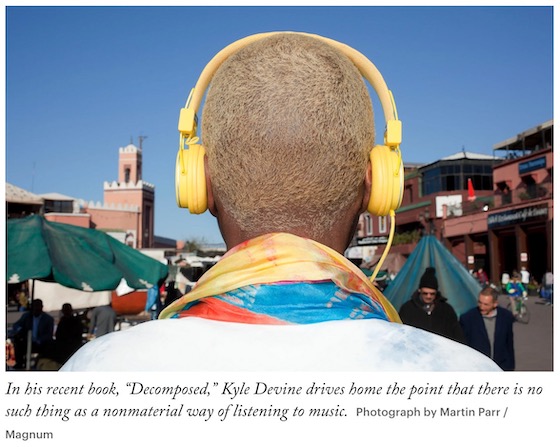
"‘The environmental cost of music is now greater than at any time during recorded music’s previous eras.’ He supports that claim with a chart of his own devising, using data culled from various sources, which suggests that, in 2016, streaming and downloading music generated around a hundred and ninety-four million kilograms of greenhouse-gas emissions—some forty million more than the emissions associated with all music formats in 2000. Given the unprecedented reliance on streaming media during the coronavirus pandemic, the figure for 2020 will probably be even greater.

The ostensibly frictionless nature of online listening has other hidden or overlooked costs. Exploitative regimes of labor enable the production of smartphone and computer components. Conditions at Foxconn factories in China have long been notorious; recent reports suggest that the brutally abused Uighur minority has been pressed into the production of Apple devices. Child laborers are involved in the mining of cobalt, which is used in iPhone batteries. Spotify, the dominant streaming service, needs huge quantities of energy to power its servers. No less problematic are the streaming services’ own exploitative practices, including their notoriously stingy royalty payments to working musicians. Not long ago, Daniel Ek, Spotify’s C.E.O., announced, ‘The artists today that are making it realize that it’s about creating a continuous engagement with their fans.’ In other words, to make a living as a musician, you need to claw desperately for attention at every waking hour."

...

“Musically, we may need to question our expectations of infinite access and infinite storage,” he writes. Our demand that all of musical history should be available at the touch of a finger has become gluttonous. It may seem a harmless form of consumer desire, but it leaves real scars on the face of the Earth.

Devine holds out hope for a shift in consciousness, similar to the one that has taken place in our relationship with food. When we listen to music, we may ask ourselves: Under what conditions was a particular recording made? How equitable is the process by which it has reached us? Who is being paid? How are they being treated? And—most pressing—how much music do we really need? Perhaps, if we have less of it, it may matter to us more.

(Via The Hidden Costs of Streaming Music | The New Yorker.)

Wednesday, October 7, 2020

Article: Why Disco Is Taking Over Pop, One Feel-Good Banger At A Time

I couldn’t be happier about it...

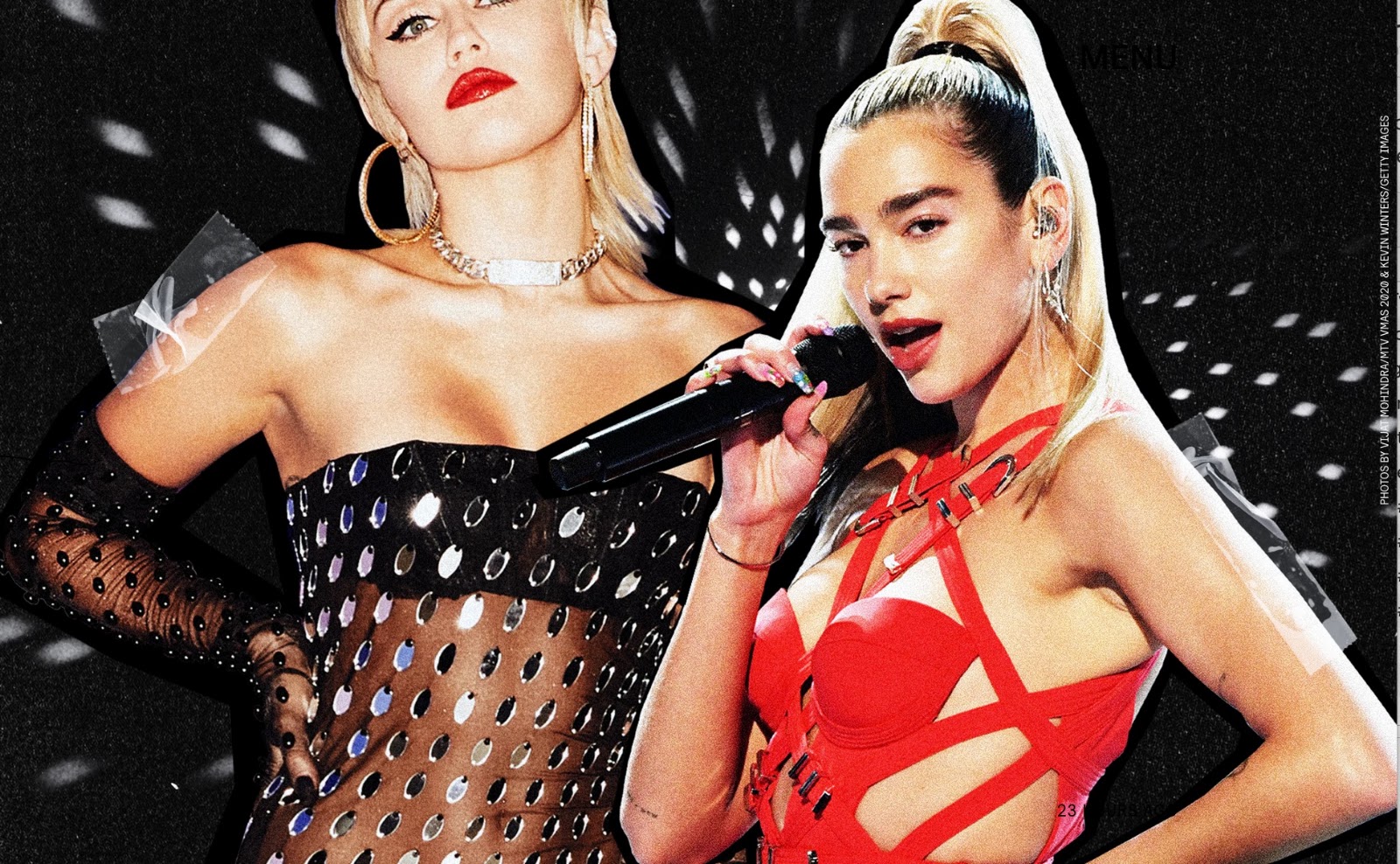
"Disco originated in the 1970s at a time of economic crisis. The post-World War II economic boom had come to an end and the United States began to endure a cycle of depression that included an oil crisis, a stock market crash, and a recession that caused high unemployment and simultaneously high inflation. At the end of the previous decade, the Civil Rights movement was disrupted by the assassinations of Martin Luther King, Jr. and Deputy Chairman of Black Panther Party Fred Hampton. Mass shootings and labor strikes abounded. With uncomplicated messages of feeling good (i.e., ‘Good Times’ by Chic, ‘You Should Be Dancing’ by the Bee Gees) and empowerment, like Gloria Gaynor’s perennial ‘I Will Survive,’ hefty funk basslines, eclectic percussion via cowbell and woodblock, and four-on-the-floor rhythms, disco was the music of liberation when marginalized, working people — in particular for queer, Black, Hispanic and Latinx, and Italian-American people — needed it badly.

It’s hard not to see parallels between the disco era and the political and cultural shifts happening right now in America. A public health crisis and subsequent recession — one started just barely 10 years after the last — plus a reinvigorated movement for racial justice, fueled by demands of significant societal restructuring in the real service of long overdue equality, make for a heavy load to bear, especially if you’re unemployed or otherwise struggling.

‘When shit’s going bad, people like to indulge in happier music,’ says Ian Kirkpatrick, the producer of ‘Don’t Start Now,’ and Lipa’s 2018 hit ‘New Rules.’ ‘These songs are so uplifting. This is a way of escaping.’"

(Via Why Disco Is Taking Over Pop, One Feel-Good Banger At A Time.)

Tuesday, July 28, 2020

Article: The Number Ones: Bonnie Tyler’s “Total Eclipse Of The Heart”

I’m not sure when I first heard this song, but I know the drama of it has always captured me.  I loved that Stereogum gave it some treatment in their series, The Number Ones, as to remind me what a spectacle this song can be.  And speaking of spectacle, I don’t remember ever seeing this video - wow!  I have no idea what’s going on in this video, but it surely lives up to the theatrical nature of the song.  There’s much to love about the campiness of this video - except maybe the creepy blue eyed choir boys.  And if there were anything that would cement Bonnie Tyler as a gay icon, it would be this video.

"Nobody’s entirely sure what ‘Total Eclipse Of The Heart’ is about, and nobody needs to know. ‘Total Eclipse Of The Heart’ overwhelms the idea of songwriting specificity in the same way that a tidal wave overwhelms a rowboat. Spend enough time with ‘Total Eclipse,’ and you might find yourself wondering if that isn’t the only way to write songs.

The term ‘power ballad’ doesn’t adequately describe ‘Total Eclipse Of The Heart,’ if only because the word ‘power’ just doesn’t have enough power. ‘Total Eclipse Of The Heart’ is an extinction-level event rendered in musical form. It’s pop music as heart-pounding, chest-thumping, blood-gargling, heavens-falling passion explosion. It’s sheer spectacle. It’s fireworks and lasers and lightning and thunder. It soars and swoops and barrel-rolls. The song flies along from one fiery climax to the next, and right when it seems like it’s about to end, it takes off again and somehow becomes even bigger. Who the fuck cares what it’s about?

Jim Steinman, the writer and producer of ‘Total Eclipse Of The Heart,’ originally came from musical theater. But you knew that. Even if you didn’t know that, you felt it. Only someone from musical theater could’ve gone for that level of cheap-seats bombast."

(Via The Number Ones: Bonnie Tyler’s “Total Eclipse Of The Heart” - Stereogum.)

Wednesday, June 3, 2020

The State of Live Music

I really miss going to concerts.  I’ve been waiting with baited breath to see when they’ll return, and i’m beginning to see some signs of life.  In the meantime, there have been a whole host of options for seeing streaming concerts.  They’re everywhere, and difficult to keep up with!  There’s also talk of this being a new normal:

Though the post-streaming music industry has been difficult for professional musicians at nearly all levels, the emergence of Couch Tour as a potentially viable income source might be one of the few positive developments in recent years. For now, it may be the perfect activity for a homebound age, both socially present and physically distant. But long after audiences return to venues, the future of Couch Tour will be something to watch."

(Via The Never-Ending Couch Tour: How Livestreams and Social Media Have Already Transformed Live Music | Pitchfork.)

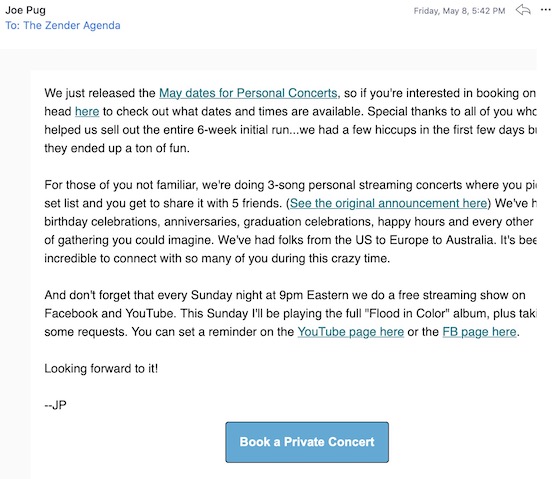
While most of these performance are just of artists and their instruments in front of a camera, some artists are showing a little more creativity.  One example are the “Personal Concerts” that Joe Pug has been offering.
 
 
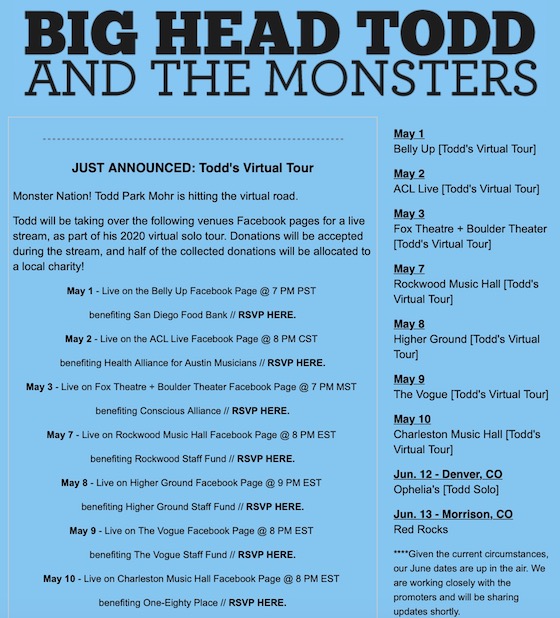
Big Head Todd & the Monsters have been doing virtual tours, supporting local communities.
 
 
But virtual concerts just aren’t the same.  I’m sure by now you’ve heard of some of these Drive In concerts happening.  One artist making some noise in the streaming space is also looking at the Drive In model as well.

"Marc Rebillet, the electronic artist and YouTuber also known as 'Loop Daddy,' is embarking on what is being called the first-ever drive-in concert tour, taking place in drive-in movie theatres in the U.S. starting in June.

The shows aim to resemble the classic drive-in movie experience by showcasing short films instead of featuring traditional opening acts, with a portion of proceeds donated to GlobalGiving Coronavirus Relief Fund."

(Via Pollstar | Marc Rebillet's 'Drive-In Concert Tour' To Hit Multiple Cities, Kicking Off In June.)

 
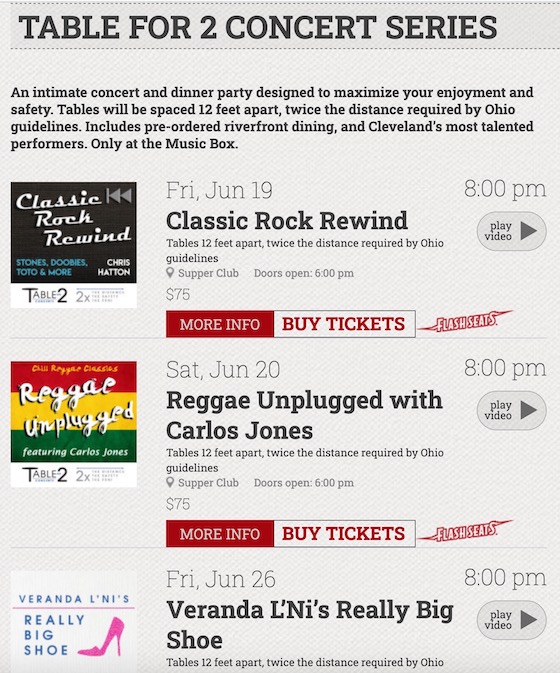
 But, things are starting to transition out of the virtual.  Music Box just started to announce the return of some dinner concerts coming in a couple weeks.
 
 
Whether or not the public is ready to jam out in public with Carlos Jones, or laugh with Veranda L’Ni in person, in the same room, is another story.  We’ll see where this goes next...

Sunday, April 26, 2020

Article: Why We Need To Support Cleveland's Grassroots Music Venues

Great article talking about the importance of structurally supporting our independent music venues, like those of our bigger name cultural institutions!

"‘We view this segment of the music business as business rather than as culture, but there are other segments of the arts that are not having to exist as pure for-profit businesses,’ says Watterson. ‘Would the [Cleveland] Orchestra be able to exist without support beyond just ticket sales? Probably not.’

If we truly want to double down on our Rock Hall fame and make Cleveland a music city, we must first realize grassroots music venues such as the Happy Dog occupy a singular place in the city, and should be treated like it."

"Why shouldn’t small clubs get similar assistance? With the vast value they provide to the community, one could even make a convincing case for zeroing their admissions tax rate out altogether.

At the very least, small clubs need an advocate. A night mayor could help them get up to code, navigate tricky tax situations and have a representative at the table. The position could be an intermediary between artists, venues and government, and promote inclusive, homegrown music. ‘I wouldn’t feel so bad about the admissions tax if some of that money went back to paying for a music promoter,’ says Barber.

By recognizing that these clubs play a unique tune, Cleveland can ensure the survival of its institutions, and stake its claim as one of the country’s great music cities."

(Via Why We Need To Support Cleveland's Grassroots Music Venues.)

Monday, April 20, 2020

Article: Why Do We Even Listen to New Music?

Looking back at history for lessons on why we find it so difficult to listen to new music.

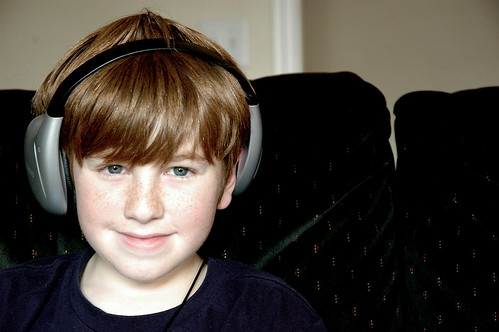
gregory & headphones
"gregory & headphones" by J. McPherskesen is licensed under CC BY-NC-SA 2.0

"Stravinsky, having already thrilled Paris with his ferociously complex Firebird ballet three years earlier, was the bright young thing of symphonic music in Paris, and The Rite was to be something essentially unheard of. Drawing from the Slavic and Lithuanian folk music of his homeland and his viscerally atavistic brain, Stravinsky blackened his score with rhythmic and harmonic tension, stretching phrases to their outer limits and never bothering to resolve them. The harmonies were difficult to name and his rhythms impossible to follow. Leonard Bernstein later described The Rite as ‘the best dissonances anyone ever thought up, and the best asymmetries and polytonalities and polyrhythms and whatever else you care to name.’

...

Many members of the audience could not fathom this new music; their brains—figuratively, but to a certain extent, literally—broke. A brawl ensued, vegetables were thrown, and 40 people were ejected from the theater. It was a fiasco consonant with Stravinsky’s full-bore attack on the received history of classical music, and thus, every delicate sense in the room. ‘One literally could not, throughout the whole performance, hear the sound of music,’ Gertrude Stein recalled in her memoir. The famous Italian opera composer Giacamo Puccini described the performance to the press as ‘sheer cacophony.’ The critic for the daily newspaper Le Figaro noted that it was a piece of ‘laborious and puerile barbarity.’"

(Via Why Do We Even Listen to New Music?.)

EDIT: I’ve been pointed to a more nuanced take of this event.

"Of all the scandals of the history of art, none is so scandalous as the one that took place on the evening of 29 May 1913 in Paris at the premiere of Stravinsky's ballet The Rite of Spring.

The Rite descended into a riot, the story goes. Magnified in the retelling, it has acquired the unquestionable certainty that only legend can have. Everyone simply 'knows' that there was a riot.

But is it possible to separate fact from fiction?"

(Via Did The Rite of Spring really spark a riot? - BBC News.)

Friday, April 10, 2020

Article: The My Generation: An Oral History Of Myspace Music

What an amazing time capsule of an article.  Lots of artists and industry folks talking about their memories of MySpace.  Looking back through all this, it was quite magical.

"Like white belts and orange cans of Sparks, Myspace so thoroughly defined the way the ’00s looked, sounded and felt that it was probably destined to not make it out of the decade alive, even if, technically, a website continues to exist at the www.myspace.com domain. But at Myspace’s height — roughly 2005 through 2008 — the website changed the way artists and fans found each other and how record labels and buzz-seeking blogs found fresh meat. Artists like Panic! At The Disco, Arctic Monkeys, Soulja Boy, Lily Allen, and Colbie Caillat would become pop stars in part because of their presence on the site, whereas artists such as Los Campesinos! or Nicole Atkins would eventually settle into cult careers after navigating through the sudden, unexpected attention the site could often generate."

Also a reminder of this massive cultural heritage loss by the company.

"It came to light that Myspace’s new owners ‘lost’ all of the music it hosted from its inception in 2003 through 2015, reportedly misplacing more than 50 million MP3s from upwards of 14 million artists, in essence completely erasing a significant part of this century’s cultural canon. What’s more, it took the company months to own up to their negligence, writing in a statement that ‘As a result of a server migration project, any photos, videos and audio files you uploaded more than three years ago may no longer be available on or from Myspace. We apologize for the inconvenience.’"

(Via The My Generation: An Oral History Of Myspace Music - Stereogum.)

Tuesday, April 7, 2020

Article: Music Streaming Subscriptions Grew by Nearly a Third in 2019

After recently asking if the vinyl & CD business can survive this pandemic, it’s curious to see the flip side of the successful streaming market.  

"Spotify still had a solid lead at the end of 2019 with 35 percent of subscriptions. However, its rivals are growing fast. Apple Music's listener base grew 36 percent to give it 19 percent of streaming, while Amazon's share grew by half to hit 15 percent. This put them comfortably ahead of rivals like Tencent (11 percent) and YouTube Music (6 percent). The remaining 14 percent of tended to be split between regional giants like India's Gaana and Russia's Yandex Music."

(Via Music streaming subscriptions grew by nearly a third in 2019 | Engadget.)

Sunday, April 5, 2020

Article: Can the Vinyl & CD Business Survive Coronavirus?


"Until recently, this year was shaping up to be strong: CD sales are down 8.3% compared to the same period last year, a far slower decline than in recent years, and vinyl sales were up 45%, even amid distribution problems. Retailers believed that this year's Record Store Day -- now postponed from April to July -- was going to be the biggest ever, and retailers are still putting in big orders, according to several labels and distributors.
Consumers still want to buy vinyl, even if many of them may not have as much money to spend for a while. 'The absence of vinyl records for several decades wasn't a death sentence for that format,' says a sales rep for a CD manufacturing plant. 'The landscape of who's left and what they do will surely change, but that doesn't mean there won't be other ways to twist a pipeline to get consumers what they want.'"
(Via Can the Vinyl & CD Business Survive Coronavirus? | Billboard.)

Saturday, March 21, 2020

Article: How Fans Can Support Artists And Music-Industry Workers During The Outbreak

More great info on how to support musicians during this difficult time… There are a lot of options on this page, many of which I’m availing myself of, but sticking with the live stream theme… 

Donate to Band Brand Identity and Website Design"Donate to Band Brand Identity and Website Design" by Higher Branding Agency is licensed under CC BY-NC-ND 4.0

"Tune in and donate to artists' livestreams

For fans who were looking forward to seeing their favorite artists live at now-cancelled shows and festivals, hundreds of those artists are now turning to platforms like Twitch, YouTube and Facebook to livestream their performances virtually. A List Of Live Virtual Concerts To Watch During The Coronavirus Shutdown The Coronavirus Crisis A List Of Live Virtual Concerts To Watch During The Coronavirus Shutdown

While these virtual shows won't be perfect financial substitutes for artists' lost touring income in the short term, the online events provide a similar sense of co-presence and community for both artists and fans. Artists and event organizers also usually include Venmo, PayPal or other payment details on their streams so that viewers can contribute financially. 'This Is Why We Play': Amid Pandemic, Philadelphia Orchestra Livestreams Beethoven The Coronavirus Crisis 'This Is Why We Play': Amid Pandemic, Philadelphia Orchestra Livestreams Beethoven

And while the widespread shutdown of the concert industry has hollowed out the popular event listings of publications like Brooklyn Veganand the New Yorker, those calendars are also quickly pivoting to virtual events as well. Publications including NPR, Pitchfork and Billboard, as well as independent initiatives like Stay At Home Fest, are maintaining their own digital event listings."

(Via How Fans Can Support Artists And Music-Industry Workers During The Outbreak : NPR.)

Friday, March 20, 2020

Article: The Never-Ending Couch Tour: How Livestreams and Social Media Have Already Transformed Live Music

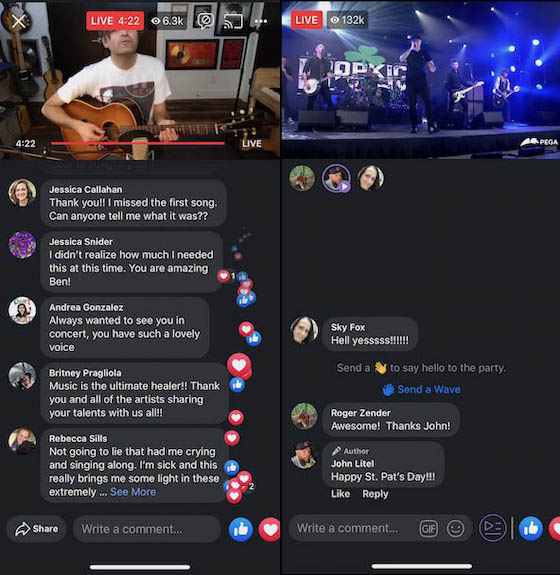
These are some bizarre times we’re in.  I’m not going to recount the details of the outbreak because you can find it all over the internet.  I’m not going to recount my own personal feelings, because I’m lucky enough to be in a better situation than most.  What I will say is that I really miss seeing live music.  It's really heartening is how all these musicians are going online to meet up with their audiences.  Below are a couple screenshots from live shows I experienced from earlier this week.  Death Cab For Cutie’s Ben Gibbard has been offering up daily performances.  Also on St. Patrick’s Day, I was invited to a watch part for the Dropkick Murphys live concert as well (132K people!).  Participating in these was strangely satisfying and fulfilling.  Pitchfork wrote an article about it, which you can find below.

"In the days since self-quarantine began, the spirit of Couch Tour has virtually gone mainstream, with livestreams coming from John Legend, Death Cab For Cutie’s Ben Gibbard, Coldplay’s Chris Martin, and Neil Young (who has previously streamed shows via his subscription Neil Young Archives site). Nugs has been working on audience-free webcasts live from several cities. Cafe Oto in London and other venues have hosted crowdless shows, and hopefully more will continue to do so.

Though the post-streaming music industry has been difficult for professional musicians at nearly all levels, the emergence of Couch Tour as a potentially viable income source might be one of the few positive developments in recent years. For now, it may be the perfect activity for a homebound age, both socially present and physically distant. But long after audiences return to venues, the future of Couch Tour will be something to watch."

(Via The Never-Ending Couch Tour: How Livestreams and Social Media Have Already Transformed Live Music | Pitchfork.) 

I’m not sure I can get behind this as a long-term business model, but I’m definitely glad we have the ability to stream these shows now.

Monday, March 9, 2020

Article: The Place Where Bone Thugs-n-Harmony Got Their Start

I’ve been reading Architectural Afterlife for a long time now.  I have my own skepticism when it comes to ruin-porn, but Johnny Joo does an excellent job in writing up detailed histories of the places he’s shooting.  I was particularly engaged on this post:


"Henderson had gone from selling LPs out of the trunk of his car in 1973 to owning 4 record stores in the 90s. He would help aspiring artists not only through mentoring, but helping them record albums or demos. He would also sell their music and promote it within these shops. Henderson has been noted as one of the main driving forces that led to Cleveland becoming one of the top three markets for rap and hip-hop between the 1990s and early 2000s. He has been referred to by many as the ‘kingpin of Cleveland hip-hop.’ Henderson worked with and promoted numerous other artists, including Dre Bone, Big Gank, Mr. Money Loc, Romey Rome, Big Ren and others. abandoned stoney burke dolls rapid creations dre bone abandoned stoney burke dolls rapid creations bone enterprise abandoned stoney burke dolls rapid creations mr money loc abandoned stoney burke dolls rapid creations big gank

Shortly after the release of their first studio album, Bone Thugs had decided to change their name to B.O.N.E. Within the year after the release of this album, they boarded a Greyhound to Los Angeles in hopes to showcase their music to their childhood idol, Eazy-E (Eric Wright) – N.W.A. founder and owner of Ruthless Records. They made calls to Ruthless Records every day, hoping to reach E. After spending nearly 3 months in Los Angeles, they had received a call back from Eazy-E himself, and had the opportunity to rap for him over the phone. Bizzy handed the phone over to Krayzie. After he said his rap, he handed the phone back to Bizzy, who then said his rap, and Eazy-E was blown away. After that, he asked where they were based out of, and upon learning that they were from Cleveland, had mentioned he had a show in Cleveland in just two weeks. Now the group had to make it back from Los Angeles to Cleveland to meet Eazy-E."

(Via The Place Where Bone Thugs-n-Harmony Got Their Start - Architectural Afterlife.)

ps. Check out his new book, and other stuff, here! https://www.oddworldstudio.com/collections

Article: The iPod-Modding Community Insists There's Never Been a Better Digital Sound

The enjoyment of listening to music on the go, without interruptions from calls, notifications, or turn directions will be greatly missed. 

"Apple may have discontinued the last of the click-wheel iPods years ago, but Pichi is part of a growing community of tinkerers giving the devices new life. It’s not just for nostalgia (though that’s part of it): iPod modders say they earnestly view the devices, with a few modern tweaks, as a superior way to listen to music. That this elite audio quality is packaged in a device that is also dear to their heart makes it even better. ‘The iPod is a pure device,’ says Sean Kirvin, 28. ‘When using an iPod all you can do is listen to music. On the surface it may seem restrictive, in reality it frees you.’ Photo: Sean Kirvin

The more popular modifications are relatively simple: updates like adding more storage or battery life, or installing firmware that allows for customization of the user interface or downloading games outside of Apple’s ecosystem. Few iPod modders are injecting the music players with wild features or stark new aesthetics.

Pichi said that he’s not that technical or ‘geeky’ but got into iPod modding after his own iPod Classic’s battery died. He couldn’t find anyone to replace it for an affordable cost and felt like he was getting ripped off, so he figured he could do it himself. ‘I got my iPod wide open there looking like busted spaghetti with wires poking up everywhere,’ he said. ‘So I just started messing around with it and changed the battery myself.’

‘I defy you to [find me] a better music playback device.’"

(Via The iPod-Modding Community Insists There's Never Been a Better Digital Sound | OneZero.)

Monday, March 2, 2020

Article: Bluetooth Upgrade Will Allow Playback on Multiple Devices at Once

Any and all improvements to Bluetooth will be appreciated! 

"the features include better battery life for devices, higher-quality audio, playback on multiple devices, and several other new capabilities.

As Ars Technica notes, one of the most significant changes to Bluetooth is LE Audio, a standardization of features that had previously been proprietary to Apple and its AirPods. LE Audio will make it possible to stream to individual earbuds, improving stereo quality for listeners, and users will be able to connect to multiple wireless speakers simultaneously.

LE Audio will also enable Bluetooth capabilities in hearing aids, making it easier for those with hearing loss to use their cell phones and watch TV. The tech allows for password-protected audio streams, too. Despite the upgrades, however, devices compatible with the new technology will take a while longer to become available."

(Via Bluetooth Upgrade Will Allow Playback on Multiple Devices at Once | Pitchfork.)

Saturday, February 8, 2020

Article: How To Like Deep House, For The Uninitiated : NPR

Instructions...

"And again, Chicago and Detroit - you had a lot of African American artists that were making electronic music. And what has made deep house music stand out is that they're not just sitting behind a board and just hitting buttons. A lot of these producers are actual musicians. So deep house brings a sense of virtuosity, a sense of musicianship to a lot of the production."
(Via How To Like Deep House, For The Uninitiated : NPR.)

Monday, January 13, 2020

Article: The Number Ones: Donna Summer’s “MacArthur Park”

I love that Stereogum just highlighted Donna Summer’s MacArthur Park as part of its series The Number Ones!  I can’t quite remember how I first discovered this song, but it’s been one of my favorite disco / Donna Summer tracks.  The original article only embedded the edited version that is under 4 minutes - but I’m including the nearly 18 minute version here, which I prefer.  It’s this version that has established itself as our official camp tear-down song, with the goal of the strike to be completed before the end of the song.  It’s good to have goals.


"‘MacArthur Park,’ in its original Richard Harris form, peaked at #2. (It’s a 6.) It didn’t fade away after that, either. It stuck around. Waylon Jennings won a Grammy for a 1969 country version of the song. The Four Tops turned it into orchestral soul in 1971. Andy Williams cut a sleepy easy-listening version in 1972. In his 1975 audition for the original Saturday Night Live cast, Andy Kaufman gave a straight-faced spoken-word recitation of the ‘MacArthur Park’ lyrics. Someone, somewhere, was going to turn ‘MacArthur Park’ into a disco song. It was inevitable. We’re lucky we got the Donna Summer version."

...

"As with the Richard Harris original, Summer recorded ‘MacArthur Park’ with the best LA studio musicians that her producers could round up. Moroder found other ways to put his literal voice into ‘MacArthur Park.’ On the chorus, the backing vocals are Moroder himself, multi-tracked into a chorus. It’s a trick that other producers would use many, many times in the decades ahead, but nobody else was doing stuff like that then. In the four-minute single edit of the song that Moroder put together, we get a swirling, histrionic, string-dominated intro that recalls the original. But then, one minute in, the beat drops, and ‘MacArthur Park turns into a gloriously hard-thumping disco jam. Summer lets out a quick whoop, but she keeps her composure, and she works overtime to keep the song’s strange emotional resonance alive."

(Via The Number Ones: Donna Summer’s “MacArthur Park” - Stereogum.)